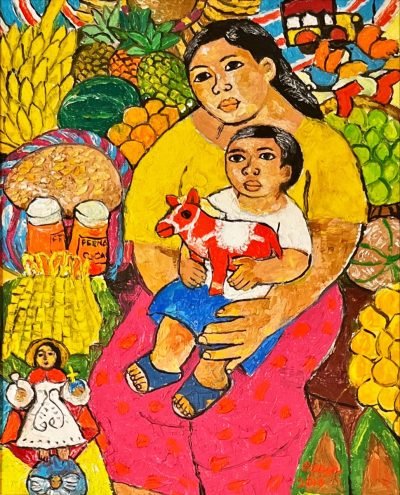
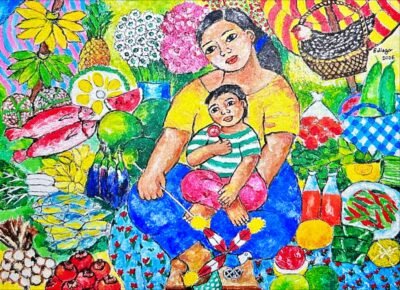
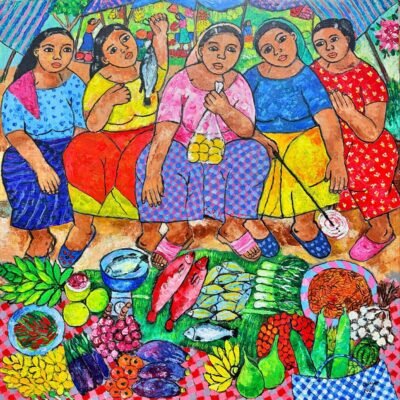
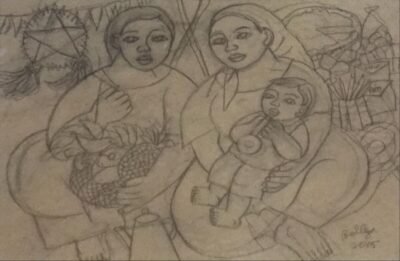
Norma Belleza (born May 3, 1939) is a highly celebrated Filipina modernist painter widely recognized as a master colorist. Born in San Fernando, Pampanga into a family of commercial billboard painters, her childhood environment steeped her early years in vivid imagery and design. She emerged onto the Manila art scene in the 1960s, initially producing dark, somber, and introspective works. After a period of artistic dormancy to focus on raising her family, Belleza experienced a creative resurgence in the mid-1970s. She shifted completely to a vibrant, polychromatic style, cementing her legacy as a champion of urban folk genre painting. Her canvases focus on the dignity, hard work, and spiritual resilience of the Filipino working class, rendering ordinary people with massive, expressive, and uninhibited physical forms.
Education: Bachelor of Fine Arts – University of Santo Tomas (UST), Class of 1962.
The Artistic Dynasty: She was married to fellow renowned modernist painter Angelito Antonio (d. 2025). Together, they passed on their creative lineage to their three children—Marcel Antonio, Emil Antonio, and Fatima Antonio Baquiran—all of whom are highly accomplished contemporary Filipino painters.
Achievements
Inaugural Solo Exhibition & Career Return: Held her debut professional solo exhibition at the prestigious Philippine Art Gallery (PAG) shortly after graduating, and later marked her major mid-career return at the Metro Gallery in 1976. This was followed by numerous successful one-person shows at landmark venues like the Luz Gallery and ABC Gallery.
Shell National Students Art Competition: Awarded Second Prize in 1961 for her powerful early painting titled Dead Christ, showcasing her immense talent even before her university graduation.
Araw ng Maynila Award for Painting: Received this prominent cultural recognition for her outstanding contributions to the enrichment of Philippine visual arts.
Diplomatic Representation: Represented the Philippines in the historic First ASEAN Symposium of Aesthetics Workshop and Exhibition, solidifying her stature among Southeast Asia’s prominent contemporary artists.
National Collection Documentation: Her life, philosophy, and distinctive folk-realist style are permanently documented in the Cultural Center of the Philippines (CCP) Encyclopedia of Philippine Art (1994) and the definitive text Self-Portraits: Twelve Filipina Artists Speak (Ateneo Press, 1999).
Artistic Legacy & Insights
Stylistic Metamorphosis: Her 1960s style was marked by heavy, melancholic, and depressing themes. Her definitive 1970s transformation broke completely from this, transitioning into bright, stylized, and almost primitive folk genre depictions utilizing thick black outlines to tone down and balance her exceptionally vivid palette.
Distortion for Strength: Instead of painting idealized, delicate figures, Belleza purposefully uses heavy distortion, broad bodies, and uninhibited physical proportions to emphasize the inner strength, fortitude, and daily survival of local market vendors, potters, peasants, and mothers.
Textural Masterclass: She deliberately eschews elegant, smooth brushwork in favor of a layered, staggered, and texturally grainier application of oil, giving her works a distinctively tactile, gritty, and rustic aesthetic that appeals deeply to collectors of raw modernist figuration.