
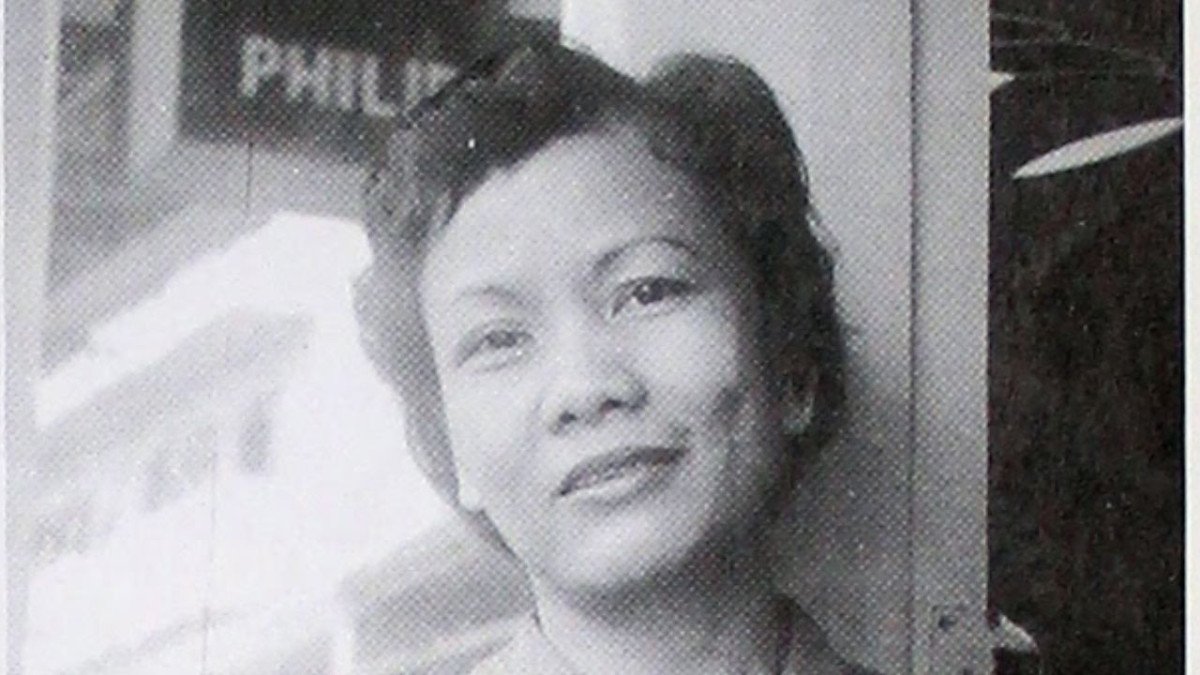
Lydia “Lyd” Cendron Villanueva-Arguilla (August 3, 1914 – December 20, 1969) emerged as a formidable pillar of Philippine mid-century modernism. Born in Manila, she initially established her creative voice as a prominent writer and journalist, earning her degree in journalism from the University of the Philippines, where she affiliated with the influential literary group The Veronicans. Her early years were deeply intertwined with her husband, the renowned fictionist Manuel Arguilla, whose tragic execution during World War II marked a crucial turning point in her life. Taking up painting around 1950 and pursuing postgraduate studies at Columbia University in New York, Arguilla absorbed global avant-garde tendencies while remaining anchored to the post-war nationalist desire for a distinct Filipino identity.
Technically, Lyd Arguilla’s paintings break away from classical academic realism through a stylized, semi-abstract lens defined by flat planes, tight spatial compression, and expressively tilted perspectives. Operating predominantly in oils and watercolors, her compositional hallmark is a narrow, elevated vertical space that creates a densely packed, rhythmic visual plane. Abandoning the idyllic lighting and pastel brilliance of the Amorsolo school, Arguilla adopted a grounded palette heavy in warm earth tones, deep ochres, and terracottas that echoed the rich complexions of her human subjects and the raw texture of local environments. Her brushwork and structural line work transformed everyday scenes into dynamic, geometric arrangements of form and tone.
As an artist and visionary cultural worker, Arguilla’s defining masterpiece was arguably institutional: in 1951, she founded the landmark Philippine Art Gallery (PAG) on Street in Ermita, Manila. The PAG became the premier sanctuary and laboratory for post-war modernists, championing pioneering artists such as Vicente Manansala, Anita Magsaysay-Ho, Arturo Luz, Fernando Zóbel, and H.R. Ocampo. Beyond her gallerist crusade, Arguilla produced compelling painted works such as Suburbia, Figures, and various landscape studies that captured post-war urban and rural transitions. Her secondary achievements spanned art criticism, cultural diplomacy, and public service, later serving as a diplomat and cultural attaché in Geneva, Switzerland.
Lyd Arguilla’s legacy in art history rests on her dual identity as a creative innovator and the principal catalyst of the Philippine modern art movement. By creating a commercial and intellectual space for modernism when conservative academic painting dominated public taste, she reshaped the nation’s visual culture. Internationally, she organized crucial overseas exhibitions that introduced contemporary Philippine painting to audiences across Asia, America, and Europe. Today, her painted works and archived writings are preserved in prestigious public and private institutions, including the Ateneo Art Gallery and the National Museum of the Philippines, cementing her reputation as an indispensable champion of 20th-century Asian art.
Highlights
- Full Name & Lifespan: Lydia “Lyd” Cendron Villanueva-Arguilla (August 3, 1914 – December 20, 1969)
- Nationality & Base of Work: Filipino; Manila, Philippines and Geneva, Switzerland
- Primary Mediums: Oil on canvas, watercolor, and ink
- Key Art Movements / Styles: Mid-Century Philippine Modernism, Semi-Abstraction, Expressionism
- Most Iconic Works: Suburbia, Figures, Landscape, and the establishment of the Philippine Art Gallery (PAG)
- Major Achievements / Recognition: Founder of the Philippine Art Gallery (PAG, 1951); Vice-Consul and Cultural Attaché in Geneva; key figure in promoting post-war Philippine modernism globally
- Themes / Significance: Tilted spatial compositions, earth-toned figuration, post-war national identity, and institutional support for avant-garde artists
- Fun Fact / Trivia: Before establishing herself as a visual artist and gallerist in 1950, Arguilla was an active member of “The Veronicans,” a pre-war group of vanguard writers who sought to modernize Philippine literature.
Short Bio
Lydia “Lyd” Villanueva-Arguilla was a groundbreaking artist, writer, gallery owner, and diplomat who served as the cornerstone of post-war Philippine modern art. As the founder of the legendary Philippine Art Gallery (PAG) in 1951, she cultivated a historic haven for modernists like Vicente Manansala, Anita Magsaysay-Ho, and Arturo Luz. Her own paintings, characterized by warm earth tones, narrow tilted spaces, and expressive semi-abstract forms, challenged conservative traditions and expanded the visual vocabulary of mid-century Asian modernism.