

Emerging from the vibrant cultural climate of fin-de-siècle Vienna, Gustav Klimt developed a visual language that challenged academic tradition and redefined the relationship between painting, decoration, and meaning. His works are immediately identifiable for their lavish ornamentation, symbolic imagery, and unapologetic exploration of sensuality—qualities that placed him at the center of artistic innovation during a period of profound social and intellectual change.
Born in 1862 in Baumgarten, near Vienna, Klimt received formal training at the Vienna School of Arts and Crafts, where he mastered classical techniques and decorative painting. His early career was shaped by commissions for architectural murals and public buildings, work that emphasized historical themes and meticulous craftsmanship. Yet as his artistic vision matured, Klimt grew increasingly dissatisfied with academic constraints, seeking instead a more expressive and psychologically charged approach to art.
This search led him to become a founding member and first president of the Vienna Secession in 1897, a movement dedicated to breaking away from conservative artistic institutions. Through the Secession, Klimt embraced symbolism and modernist experimentation, drawing inspiration from Byzantine mosaics, Japanese prints, and the fluid lines of Art Nouveau. His celebrated “Golden Phase,” marked by the extensive use of gold leaf, transformed the painted surface into a radiant field of pattern and meaning, where figures seem to exist between reality and myth.
Works such as The Kiss, Portrait of Adele Bloch-Bauer I, and Judith and the Head of Holofernes exemplify Klimt’s ability to fuse intimacy with monumentality. Female figures dominate his compositions, portrayed as powerful, enigmatic, and often erotic presences. These images sparked controversy in their time, challenging conventional morality while asserting the legitimacy of desire, autonomy, and inner life as subjects of serious art.
In his later years, Klimt shifted toward more fluid brushwork and expressive color, integrating natural motifs and softer forms while retaining his symbolic intensity. His sudden death in 1918 curtailed a career that had already reshaped European modernism, yet his influence endured—resonating through the works of Egon Schiele, Oskar Kokoschka, and generations of artists drawn to the intersection of ornament, emotion, and meaning.
Highlights
- Full Name & Lifespan
Gustav Klimt (1862–1918) - Nationality & Base of Work
Austrian; primarily active in Vienna - Primary Mediums
Oil painting, decorative murals, drawings, mixed media with gold leaf - Key Art Movements / Styles
Symbolism, Art Nouveau (Jugendstil), Vienna Secession, early Modernism - Most Iconic Works
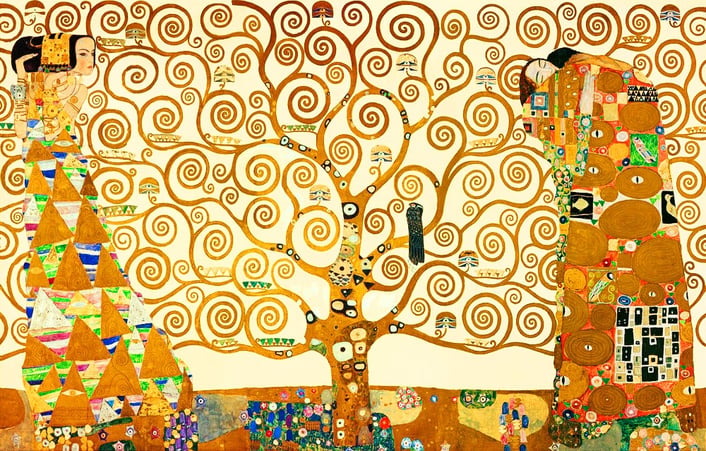
The Kiss, Portrait of Adele Bloch-Bauer I, Judith and the Head of Holofernes, The Tree of Life - Major Achievements / Recognition
Founder and first president of the Vienna Secession; internationally recognized as a leading figure of European modern art; works housed in major museums and among the most valuable paintings ever sold - Themes / Significance
Desire, intimacy, femininity, life and death, mythology, psychological depth, and the fusion of fine art with ornament - Fun Fact / Trivia (optional)
Klimt often worked wearing a loose painter’s smock and avoided public appearances, preferring a private life despite his growing fame
Short Bio
Gustav Klimt was an Austrian painter whose richly ornamental and symbol-laden works transformed the visual language of modern art. As a central figure of the Vienna Secession, he rejected academic conventions in favor of a bold synthesis of symbolism, sensuality, and decorative abstraction. Renowned for his use of gold leaf and psychologically charged imagery, Klimt explored themes of desire, identity, and the human condition with unprecedented openness. His legacy endures as a defining bridge between nineteenth-century symbolism and twentieth-century modernism.